How to Get a Job in Pharmaceutical Companies After B.Pharm
Back to blog
January 9, 2026
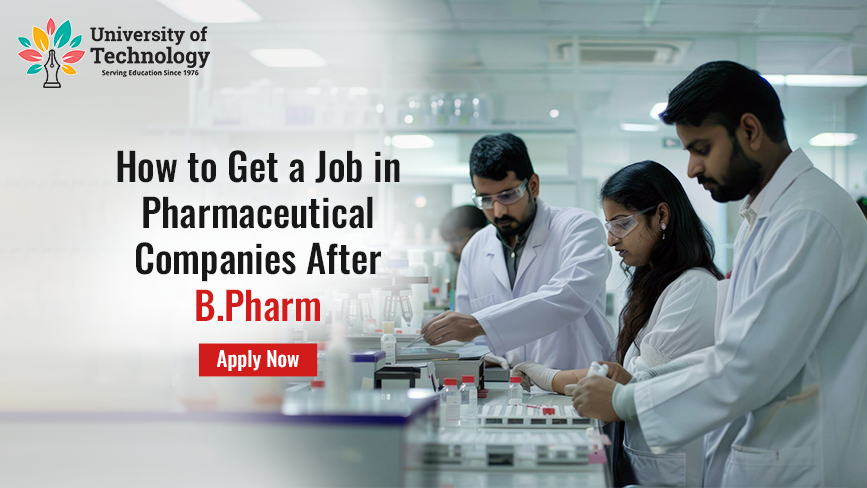
Finishing B.Pharm feels like a relief for most students. Years of theory, labs, exams and practical files finally come to an end. But once college life slows down, another thought quietly starts bothering many students. What comes next. Getting a job in a pharmaceutical company sounds like the obvious step, yet for many graduates, the path does not feel clear at all.
Some students believe jobs are limited. Others feel they do not know enough. A few apply randomly and wait. This confusion is very common and it does not mean the student lacks ability. In most cases, it simply means no one explained how the industry actually works and what companies really look for.
At the University of Technology, we see this situation every year. Students are capable, sincere and willing to work hard, but they are unsure where to start. The good news is that pharmaceutical companies do hire fresh B.Pharm graduates. What matters is how you prepare and how clearly you understand your direction.
Understand Where B.Pharm Graduates Fit In
Pharmaceutical companies are not only about making tablets and capsules. There are many departments working together. Because of this, B.Pharm graduates can enter the industry through different roles.
Some students work in production units, where medicines are manufactured. Others work in quality control or quality assurance, where checking, testing and documentation are important. There are also roles in research support, regulatory work, clinical research coordination and even sales and marketing.
Not every role suits every student. This is why understanding your interest early helps. A student who enjoys lab work may not enjoy marketing, and someone who likes communication may not feel comfortable in production.
Be Honest About What You Like and What You Don’t
Many students make the mistake of following what others are doing. If friends are applying for quality control jobs, they apply too. If someone says regulatory affairs is in demand, everyone rushes there.
This rarely works well.
It helps to pause and ask yourself a few basic questions. Do you enjoy lab work. Are you comfortable with machines and processes. Do you like reading guidelines and maintaining records. Or do you prefer interacting with people.
Your answers matter more than trends. At the University of Technology, we always tell students that choosing the right role matters more than choosing a popular role.
Strengthen the Basics You Already Studied
Pharma interviews are usually not very complicated, but they are very basic. Interviewers often ask simple questions from subjects you already studied. Pharmaceutics, pharmacology, pharmaceutical chemistry, quality management and basic production concepts come up often.
You do not need to memorise textbooks. But you should be able to explain concepts in simple words. What is tablet coating. Why are stability studies done. What is GMP. These are common questions.
Students who revise basics calmly and slowly usually perform better than those who panic and try to study everything at once.
Practical Exposure Makes a Big Difference
One of the biggest advantages a student can have is practical exposure. Companies prefer candidates who understand how work happens on the shop floor or in labs.
Industrial training, internships or short term practical programs help a lot. Even six months of experience can change how confidently you speak in interviews.
If possible, try to get exposure in manufacturing units, testing laboratories or research centres. If that is not immediately available, even training programs focused on industry practices can help bridge the gap.
At the University of Technology, we encourage students to value practical learning as much as marks.
Learn Skills That Companies Actually Use
Apart from subject knowledge, pharma companies expect certain work habits.
Documentation is very important in this industry. Every process, test and change must be recorded. Learning how to write reports, maintain records and follow procedures is useful.
Basic computer knowledge is also important. Many students overlook this, but a lot of pharma work today happens on systems, not on paper.
Communication also plays a role. You may need to explain your work, share observations or raise issues, and doing this clearly makes daily work easier.
These are small things, but they make a big difference when companies compare candidates.
Create a Simple Resume That Makes Sense
Your resume does not need to look fancy. It needs to be honest.
Mention your education, training, internships and practical exposure clearly. If you worked in a lab or plant, describe what you actually did. Avoid listing skills you cannot explain.
A clean and truthful resume builds trust. Interviewers usually sense exaggeration very quickly.
Apply in the Right Way and Be Consistent
Many students apply once or twice and then wait. This is not enough.
Pharma companies hire through different methods. Company websites, campus drives, walk-in interviews, referrals and job portals all matter. It also helps to keep an eye on company updates and job notices instead of checking only once in a while.
Applying regularly does not mean applying blindly. Read job roles, match your profile and then apply.
Consistency matters more than luck.
Prepare for Interviews Like a Real Conversation
Pharma interviews are usually calm and technical. Interviewers want to see whether you understand what you studied and whether you are serious about the role.
If you do not know something, it is better to say so honestly. Guessing or giving random answers creates a bad impression.
Confidence does not come from memorising answers. It comes from understanding basics and being honest.
Higher Studies Are an Option, Not a Compulsion
Some students choose M.Pharm or certifications after B.Pharm. This can help for research roles, teaching or specialised fields.
Short courses in clinical research, regulatory affairs or quality management may also help, if chosen carefully.
But higher studies should be a planned decision, not something done only because a job did not come immediately.
Patience Matters More Than People Admit
The first job may take time. Rejections happen. Delays happen. This is normal.
Many professionals working in good pharma positions today did not get their first job immediately. What helped them was patience, learning and regular effort.
At the University of Technology, we remind students that careers are built slowly. One step leads to another.
Conclusion
Getting a job in a pharmaceutical company after B.Pharm is possible. It requires clarity, preparation and effort, not shortcuts.
Understand the industry. Choose a direction that suits you. Strengthen your basics. Gain practical exposure. Apply consistently and stay patient.
At the University of Technology, we believe graduation is only the beginning. What shapes your future is how you move forward after it. Keep learning, stay honest with yourself and do not rush the process.
Your place in the pharmaceutical industry will come when preparation meets opportunity.
Download
Download University Material like Brochure, Flyers, Logo.
 Apply Now
Apply Online for Admission
Apply Now
Apply Online for Admission
 Scholarship
To Get more info about Scholarship provider by University
Scholarship
To Get more info about Scholarship provider by University
 International Admissions
Find the Procedure for International
International Admissions
Find the Procedure for International

Scholarship
To Get more info about Scholarship provider by University
Announcements
Examination Forms for the January 2026 Main/Back/Re-Exam are available.
Road Safety Awareness Activity- “Drive Safe-Arrive Safe”
Applications are invited for Doctorate of Philosophy (Ph.D).
January 2026 Session
View All
January 2026 Session
- B.A. ( LLB )
- B.A. (Pass Course)
- B.Com ( Pass Course)
- B.Lib and Information Science
- B.Pharma
- B.Sc (Bachelor of Science)
- B.Tech
- BBA ( Bachelor of Business Administration)
- BBA in Capital Market
- BCA
- Certificate in Library Science
- D.Pharma
- Diploma in Engineering
- LLB
- LLM
- M. Pharm (Pharmaceutical Quality Assurance)
- M. Pharm (Pharmaceutics)
- M. Pharm (Pharmacology)
- M.A. ( Pass Course)
- M.Lib and Information Science
- M.Pharma
- M.Sc. (Master of Science)
- M.Tech
- MBA (Specialization)
- MCA
- Ph.D.
- School of Basic and Applied Sciences
- School of Commerce, Management and Computer Applications
- School of Engineering & Technology
- School of Humanities, Arts and Social Sciences
- School of Law
- School of Pharmacy